
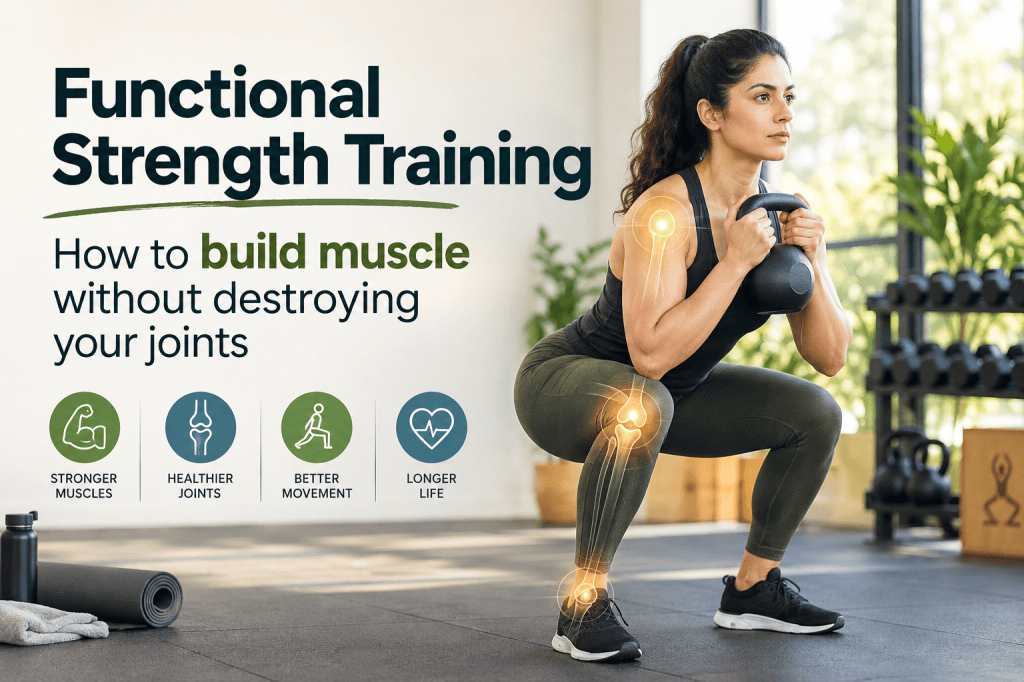
If your post-workout routine routinely includes ice packs, anti-inflammatories, or a nagging sense that your joints are taking a beating, something is wrong.
For decades, traditional fitness culture has taught us that progress requires pushing through pain. We were told to chase muscle isolation on machines or overload heavy barbells week after week. But for many active adults, this approach leads directly to knee wear, shoulder impingement, or chronic lower back tightness.
Building a strong, resilient body shouldn’t come at the expense of your joints. That’s where functional strength training comes in—an approach that bridges physical rehabilitation and athletic conditioning to help you build real-world strength that lasts a lifetime.
1. Isolation vs. Integration: Why Traditional Workouts Fail Your Joints
Most traditional gym routines isolate single muscles: chest press, leg extension, bicep curl. While isolation exercises have a place in bodybuilding, they don’t reflect how human bodies naturally move.
When you isolate a muscle, you often force a single joint to bear heavy loads without help from surrounding stabilizer muscles. For instance, heavy seated leg extensions put intense shear stress on the knee joint.
Functional strength training focuses on integration, not isolation. Instead of training a isolated muscle group, it trains full movement patterns. When your glutes, core, hamstrings, and ankles work together in a functional squat, the load is distributed evenly across your kinetic chain—protecting your knees and lower back from excessive stress.
2. The 5 Core Human Movement Patterns
A safe, joint-friendly functional workout revolves around five fundamental movements that mimic real-life activities:
1. Squat (Lower Body Push): Sitting down and standing up gracefully.
2. Hinge (Lower Body Pull): Bending at the hips to lift objects off the floor safely without straining your lower back.
3. Push (Upper Body): Pushing doors, heavy objects, or pushing yourself off the ground.
4. Pull (Upper Body): Rowing or pulling objects toward your body to maintain strong posture.
5.Carry (Locomotion & Core): Carrying groceries or luggage while maintaining upright alignment and core stability.
By balancing these five patterns in every routine, you eliminate muscle imbalances, protect your spinal integrity, and build strength that translates into everyday life.
3. Simple Joint-Friendly Exercise Substitutions
You don’t need to stop lifting weights to protect your joints—you just need smarter exercise selection. Here are three joint-friendly substitutions you can try:
Swap Overhead Barbells for Landmine Presses: Pressing directly overhead can compress tight shoulders. A landmine press allows you to push at an angled trajectory, offering shoulder-friendly upper body strength.
Swap Heavy Back Squats for Goblet Squats: Holding a kettlebell or dumbbell in front of your chest naturally engages your core, holds your torso upright, and reduces compressive forces on your lumbar spine.
Swap Conventional Deadlifts for Trap Bar Deadlifts: The neutral grip on a trap bar centers the weight with your body’s center of gravity, taking significant stress off your lower back.
4. Build Real Strength Without Pain at PX6
Strength training should make your body feel resilient, light, and capable—not stiff and aching. By combining clinical movement principles with progressive resistance, you can build muscle, increase bone density, and safeguard your joints for years to come.
Whether you are recovering from an old injury, looking to start a joint-friendly routine, or want your movement technique analyzed by professionals, we are here to support you.
👉 Ready to build strength that feels good?
Explore our Group Fitness Classes or book a 1-on-1 Personal Training Assessment today at PX6 to start moving pain-free.
 PX6 Fitness and Energy Healing Center