
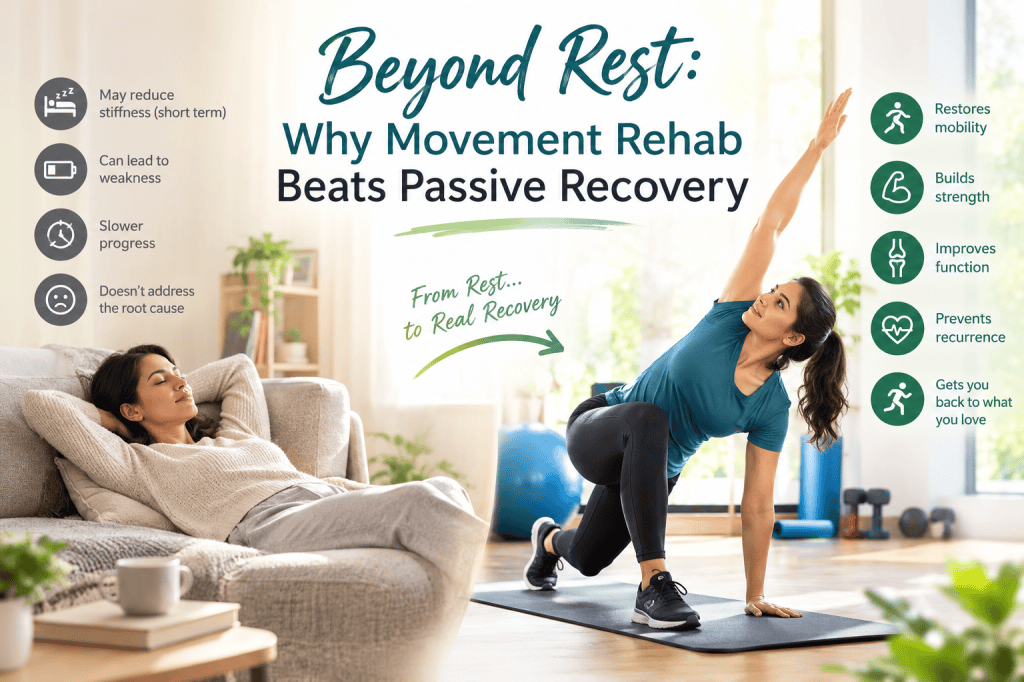
For generations, the standard advice for sudden lower back pain was simple: lie down, take painkillers, and rest until the pain goes away.
However, modern sports medicine, neuro-physiotherapy, and spine research have made one thing overwhelmingly clear: strict bed rest often prolongs back pain rather than fixing it.
While short periods of modified rest can help ease initial acute spasms, prolonged passive recovery causes muscles to weaken, joints to stiffen, and fear of movement to take root. At PX6 , we advocate for movement-based rehabilitation—an active, evidence-driven approach that uses controlled exercise to restore function, relieve spinal compression, and prevent recurrent flare-ups.
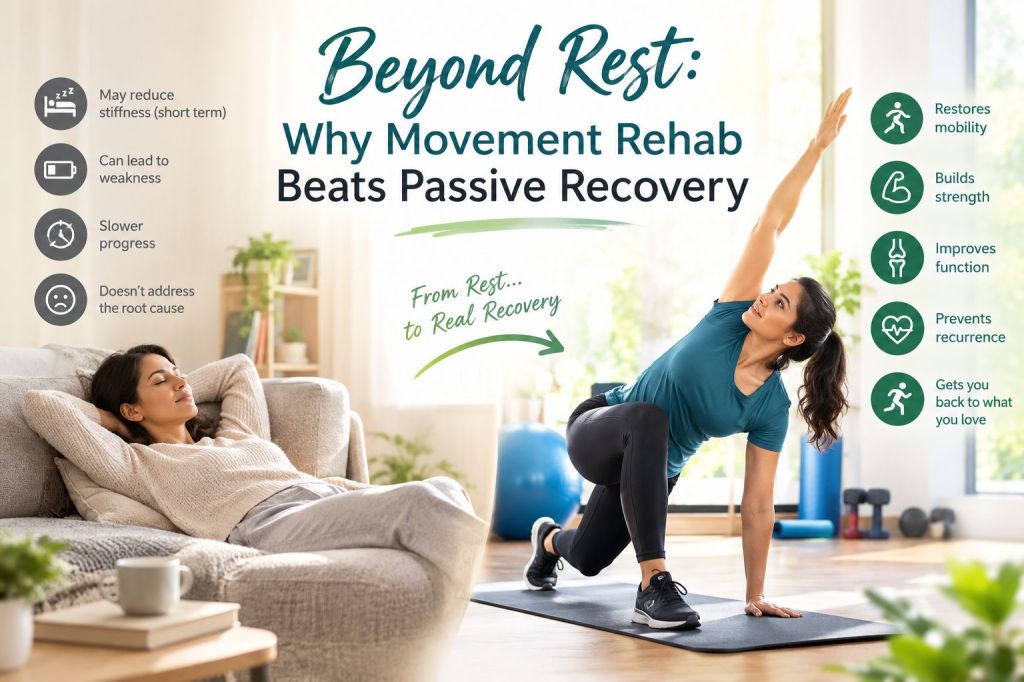
The Myth of Strict Bed Rest
When your back hurts, resting feels like the safest choice. However, staying immobile for more than 24 to 48 hours sets off a counterproductive physiological chain reaction:
- Muscle Deconditioning: The lumbar stabilizers and deep abdominal muscles rapidly lose strength when inactive, leaving your lumbar spine with less structural support.
- Reduced Tissue Circulation: Intervertebral discs rely on movement to pump oxygen-rich fluid and nutrients into the spinal structures. Total rest slows down cellular repair.
- Increased Stiffness: Immobilized spinal joints and surrounding fascia tighten up, making your first steps after resting feel far more painful than before.
What Is Movement-Based Rehabilitation
Movement-based rehabilitation is not about jumping into heavy workouts or ignoring your body’s signals. It is a structured progression of targeted movements, joint mobilization drills, and neuromuscular re-education tailored to your specific tissue tolerance.
Instead of passively relying on heating pads, ice packs, or temporary massages, active rehabilitation trains your nervous system to feel safe moving again.
Key takeaway: Pain isn’t always a sign of tissue damage; often, it is your nervous system raising a protective alarm. Controlled movement lowers that alarm threshold.
How Active Movement Heals the Lumbar Spine
When guided by a qualified physical therapist, movement acts as an active healing agent in several distinct ways:
- Promotes Disc Hydration & Tissue Repair: Controlled spinal flexion, extension, and gentle rotation act like a pump, driving blood flow and hydration directly into damaged lumbar discs and ligaments.
- Re-educates Muscle Activation Patterns: Active movement teaches your glutes, core muscles, and spinal erectors to fire in proper sequence, protecting your lower back during everyday movements like bending or lifting.
- Breaks the Fear-Avoidance Cycle: Avoiding movement out of fear creates a hypersensitive brain response. Gradual exposure to safe movement restores movement confidence.
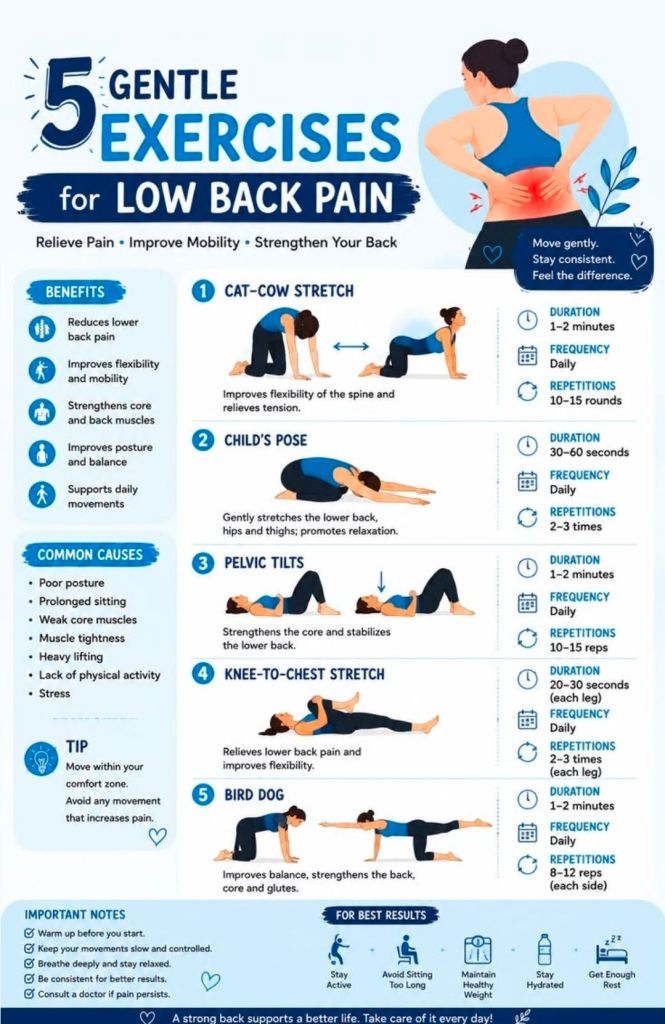
3 Low-Impact Active Recovery Exercises to Try
If you are experiencing mild-to-moderate back stiffness, these gentle, non-destructive movement drills can help restore mobility:
- Cat-Cow Stretch : Spinal mobilization in a quadruped position
Start on your hands and knees. Inhale as you gently arch your spine toward the floor, lifting your head and tailbone. Exhale as you round your back toward the ceiling, tucking your chin. Perform 10 to 12 slow, controlled repetitions. - Bird-Dog : Core and pelvic stabilizer activation
Remain on all fours with a flat spine. Extend your right arm forward and left leg backward simultaneously until both are parallel to the floor. Hold for 2 seconds, return to the start position, and alternate sides for 8-10 reps per side. - Glute Bridges : Posterior chain re-activation without spinal stress
Lie flat on your back with your knees bent and feet flat on the floor. Squeeze your glutes and lift your hips until your body forms a straight line from knees to shoulders. Pause at the top for 2 seconds before lowering slowly. Complete 12 to 15 reps.
Reclaim Your Spinal Health at PX6
Lower back pain does not have to dictate your daily life. By replacing passive rest with targeted movement-based rehabilitation, you give your spine the exact environment it needs to recover, adapt, and build long-term resilience.
At PX6, our hybrid approach brings together clinical physiotherapy assessments, individual movement re-education, and functional fitness programming to ensure you recover safely and move pain-free.
Ready to move beyond back pain?
Book a comprehensive Physiotherapy & Spine Assessment or schedule a Personalized Rehabilitation Session today at PX6 Fitness, Physiotherapy and Energy Healing Center.
 PX6 Fitness and Energy Healing Center