
If you finish your workday with a dull, throbbing ache at the base of your skull, tight upper traps, or a heavy sensation in your shoulders, you are far from alone.
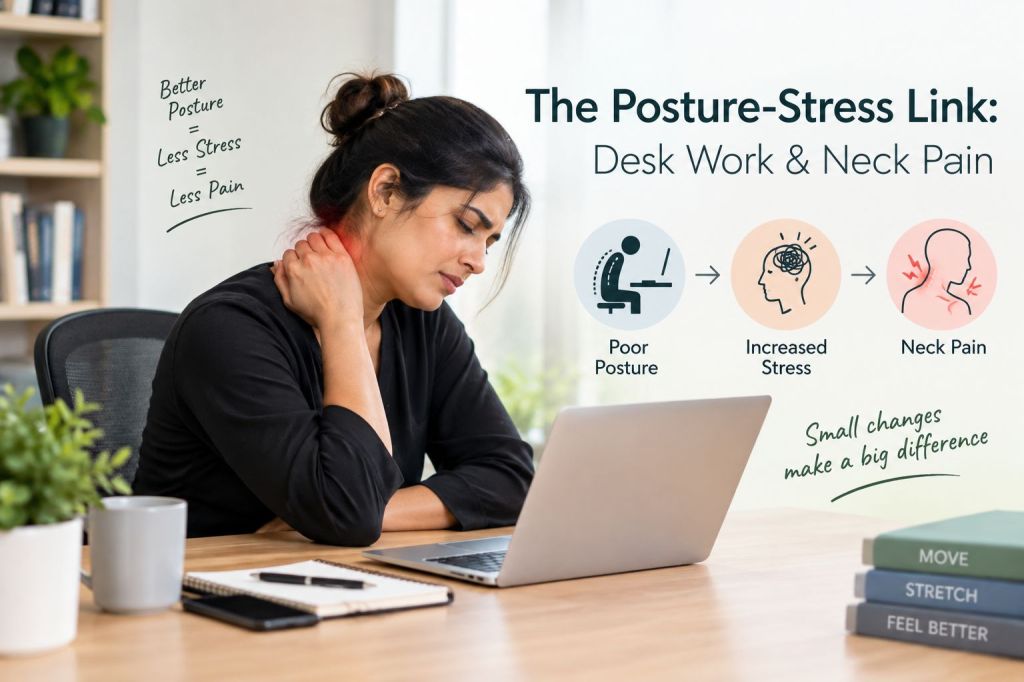
In today’s digital-first workplace, hours of sitting in front of laptops and screens have made neck stiffness and tension headaches two of the most common physical complaints among working professionals. While many blame their chair or monitor height, the root cause is often a compound issue: the direct interplay between physical posture and mental stress.
At PX6, we take a bio-psycho-social approach to pain management—helping you understand how mechanical strain and nervous system stress interact, and how targeted movement can break the cycle.
The Physics of “Text Neck” & Forward Head Posture
Your head weighs approximately 4.5 to 5.5 kilograms (10 to 12 pounds) in a neutral, upright position. However, as you lean forward to read emails or peer at a screen, gravity amplifies that load exponentially:
- 15-degree forward tilt: Feels like 27 lbs (12 kg) on your cervical spine.
- 30-degree forward tilt: Feels like 40 lbs (18 kg) on your cervical spine.
- 45-degree forward tilt: Feels like 49 lbs (22 kg) on your cervical spine.
When you maintain forward head posture for hours, the delicate suboccipital muscles at the base of your skull and the upper trapezius muscles remain in a constant state of micro-contraction. Over time, these overworked muscles develop painful trigger points that radiate pain upward into your temples, behind your eyes, and across your forehead—creating classic tension headaches.
The Stress Factor: How Cortisol Keeps Your Neck Locked Up
Mechanical strain is only half the story. Mental stress from tight deadlines, high workload, or constant digital multi-tasking triggers your body’s fight-or-flight nervous system response:
- Shallow Chest Breathing: Stress causes you to shift from deep diaphragmatic breathing to shallow chest breathing. This forces neck muscles (like the scalenes and sternocleidomastoid) to work as primary breathing muscles, overworking them thousands of times a day.
- Unconscious Shoulder Guarding: Under stress, the nervous system instinctively elevates the shoulders toward the ears as a protective reflex, trapping tension in the upper back and neck.
- Increased Pain Sensitivity: Elevated stress hormones (like cortisol) lower your pain threshold, turning minor muscle tightness into acute, distracting headaches.
3 Quick Desk-Side Relief Drills
You don’t need an hour-long routine to relieve cervical strain during the workday. Performing these three 60-second micro-breaks every 2 hours can reset your posture and soothe your nervous system:
Chin Tucks (Cervical Retraction)
- Sit tall with your back supported.
- Without tilting your head down, gently pull your chin straight back as if making a “double chin.”
- Hold for 3 seconds, release, and repeat for 10–12 repetitions.
- Why it works: Decompresses the upper cervical spine and strengthens weak deep neck flexors.
Upper Trap Stretch with Diaphragmatic Breath
- Sit on your right hand to anchor your right shoulder down.
- Gently tilt your left ear toward your left shoulder until you feel a comfortable stretch along the right side of your neck.
- Take 5 deep belly breaths, exhaling slowly to signal relaxation to your nervous system.
- Switch sides and repeat.
Scapular Squeezes & Thoracic Extension
- Place your hands behind your head or lower back.
- Inhale deeply, open your chest, and pull your shoulder blades back and together.
- Hold for 3–5 seconds, then relax on the exhale. Repeat 8–10 times.
- Why it works: Reverses the rounded-shoulder, slouched posture caused by typing.
Break the Pain Cycle at PX6 Fitness, Physiotherapy and Energy Healing Center
Temporary relief through pain relievers or quick rubs only masks the symptoms. Lasting relief requires restoring optimal spinal alignment, retraining deep neck stabilizers, and calming an overactive nervous system.
At PX6, our integrated approach combines clinical physiotherapy, ergonomic guidance, and holistic nervous system reset sessions (including specialized mobility work and energy healing) to eliminate desk-related neck pain and tension headaches at the root.
Tired of working through neck tightness and daily headaches?
Book a comprehensive Posture & Cervical Assessment or schedule a Personalized Healing Session today at PX6 to restore comfort and focus to your workday.

