
If your social feeds have been filled with indoor stadium races, sled pushes, and mass running loops lately, you are looking at HYROX. Billed as the “World Series of Fitness,” HYROX has quickly transformed from a niche challenge into a global mass-participation sport.
Combining accessible functional movements with intermediate endurance running, HYROX gives everyday gym-goers a concrete goal to train for.
What is a HYROX Event?
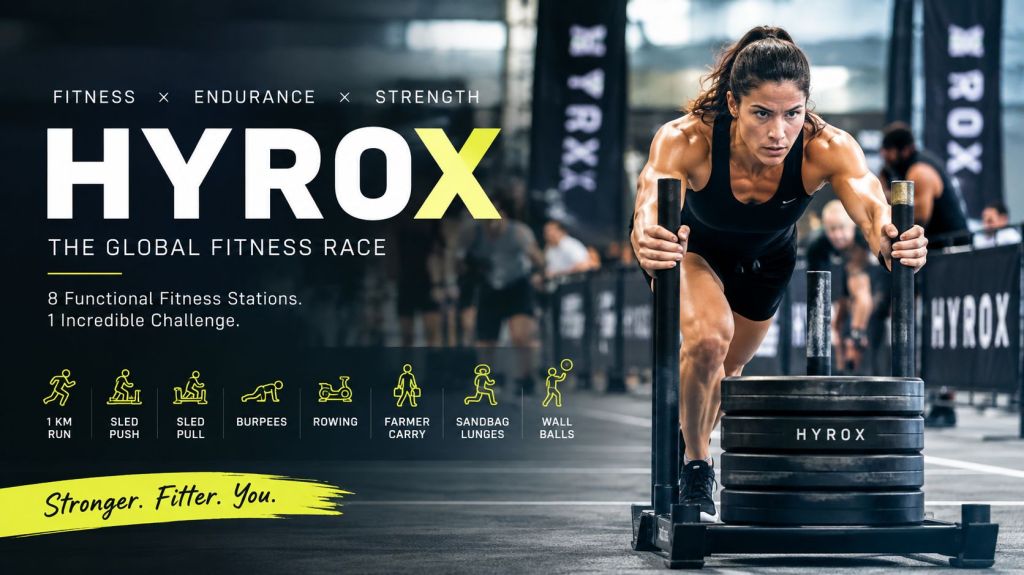
Every HYROX race follows the exact same standardized layout across the globe. Whether competing in London, New York, or Singapore, the race consists of 8 laps of a 1 km run, each followed by 1 functional workout station:
- 1 km Run + 1,000m SkiErg
- 1 km Run + 50m Sled Push
- 1 km Run + 50m Sled Pull
- 1 km Run + 80m Burpee Broad Jumps
- 1 km Run + 1,000m Row
- 1 km Run + 200m Farmer’s Carry
- 1 km Run + 100m Sandbag Lunges
- 1 km Run + 100 Wall Balls
Why is HYROX Trending Right Now?
- Standardized Leaderboards: Because the format never changes, athletes can accurately compare their finish times against peers worldwide.
- Low Skill Barrier: Unlike CrossFit, which often features complex Olympic weightlifting or advanced gymnastics, HYROX utilizes foundational human movements (pushing, pulling, running, jumping).
- High-Energy Community: Race days take place in massive convention centers complete with roaring crowds, DJ sets, and vibrant lights, creating a marathon-like atmosphere.
- Inclusive Race Categories: Competitors can enter under Singles (Open or Pro), Doubles, or 4-Person Relays, making it approachable for all fitness levels.
How to Prepare for Your First HYROX
To cross the finish line feeling strong, structure your training around three key pillars:
- Build Running Volume: Running makes up half of the event (8 km total). Focus on steady-state zone 2 cardio and interval runs.
- Train “Compounded Fatigue”: Practice running immediately after high-intensity stations (e.g., a 1 km run right after heavy sled pushes or wall balls) to adapt to compromised legs.
- Master Grip & Core Stamina: Exercises like the Farmer’s Carry and Sled Pull tax your forearms and core—fortify these areas during accessory work.

